- Pickleball Studio Newsletter
- Posts
- Spartus P1 is This Grit Durabilty Done Right?
Spartus P1 is This Grit Durabilty Done Right?

Chris Olson
February 06, 2026

What’s up, guys? Long time no chat. I’m finally back from my yearly January break, and there’s a lot to talk about. Hope you’ve all been doing well. First, a poll for you below.
How much does grit durability matter to you?Companies are starting to focus on longer lasting textures for their paddles. It's well known raw carbon fiber wears pretty quickly, but I want to know how much you guys even care about these textures. |
Spartus P1 Review | This is Genuinely Exciting

You can use code PBSTUDIO to save 10%

For the first full review back this year, we are looking at the new Spartus P1. I chose this one as my first review back because of what Spartus is calling Permagrit.
This is their longer lasting textures to compete with Selkirk’s Infinigrit, Six Zero’s Diamond Tough, and so on.
We’ve been working hard on grit durability tests, because no one has really put them through the tests yet. It’s been a lot of work, but we are finally starting to get some interesting results.
I highly recommend you watch the full review to find out all the details, but at the moment Permagrit is the most promising long lasting texture we have tested so far.
We have put in the equivalent of 84 games on the paddle, and seen virtually a 0% drop in surface roughness and RPM. Which is insane, because everything else we have tested so far has usually shown a drop within 30 games.

This is a chart of surface roughness after 80-100 games. As you can see, the raw carbon fiber paddles lost 20% roughness after 100 games, and the Spartus P1 only dropped 0.68%
We are working on finishing our tests on Six Zero’s Diamond Tough, Selkirk’s Infinigrit, and 11six24’s Hex Grit but right now it’s clear that:
Permagrit is really good
Raw Carbon Fiber wears down really fast.
With paddle performance leveling off, and the main differences coming down to the feel of the paddle, innovations like a truly longer lasting texture are really exciting. I hope we keep seeing more companies figure this out.
One last note, I think it’s important to remember that it’s unlikely that any texture is going to last forever. I’d even argue that it might be a pretty big stretch to even expect 6 months or up to a year without noticeable drops in spin.
But honestly, that’s just sports equipment in my opinion. I don’t think it’s reasonable to expect elite performance for 6 months to a year. Maybe someone will prove me wrong though.
Upcoming paddles
There are a lot of upcoming paddles, if you want to stay in the loop, here is the latest list I have.
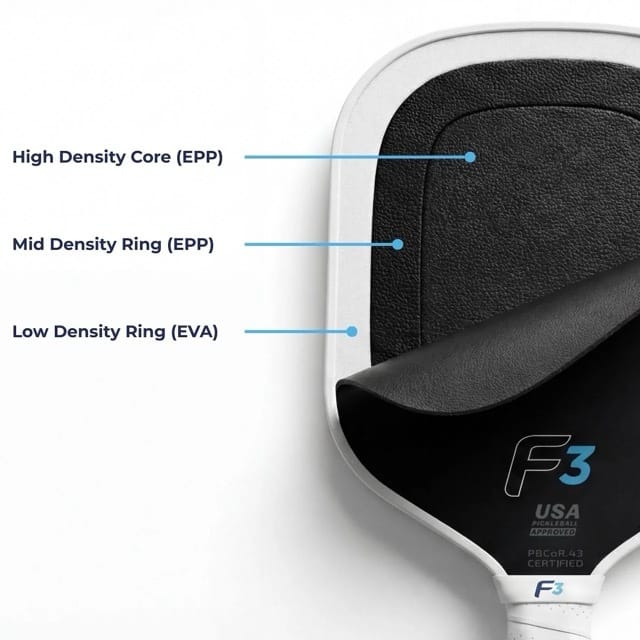
FLIK F3
Release date: Launched already
Price: $190
What’s special?
3 layer foam core. The design looks like it made a floating foam core, float more. haha.
Haven’t hit this yet, but curious to see how it stacks up.
Chorus CODA

Release date: Feb 10th
Price: $174.99
What’s special?
It’s using 3 different types of foam in the core instead of 2. Whether this has a big impact on performance, we’ll have to see.
I haven’t hit this one yet, so I don’t have any context for how it plays.
This version will not have Harmony Grit on it (The name of Chorus’ long lasting texture). It sounds like a version with Harmony grit will come later. Which begs the question in my mind, why even release a version without it? Maybe it’ll take longer to get approved and this will be a good filler in the meantime. Not sure.
Holbrook FUZE
Release date: Feb 12th
Price: $229
What’s special?
They’ve taken their dual density concept from the Arma and done the same with the foam. While I’m skeptical that is necessary, or even beneficial, we’ll have to see how it holds up. The dual density concept of the Arma didn’t seem to have any meaningful performance benefits.
11six24 Vapor Power2

Release: Roughly Feb 13th
Price: $210
What’s special?
Their long lasting texture called Hex Grit. We are currently in the process of testing this. Early signs seem good, but it’s too early to really know.
It’s a full foam paddle that appears to be built similarly to many others on the market. So, if the grit holds up, it’ll be another good option alongside the Spartus P1, with a different play profile. Which would be good, since the Spartus P1 isn’t going to be everyones cup of tea.
It’s pretty light
We’ve done a first impressions already if you want to check it out.
Head Triflex Radical

Release: Feb 26th
Price: $199
What’s special?
Head really hasn’t done anything relevant in Pickleball that I have ever seen. But these new paddles apparently have a mix of EVA, EPP, and polymer. Haven’t seen anyone do that before, so it does make me wonder how that’s going to perform. I would say I have low expectations, but I’m open to being surprised.
Speedup Tide

Release: Feb 17th
Price: $159.99 (I think this is a presale price?)
What’s special?
These appear to be 14mm variants of the popular Inferno from what I have gathered. There may be some other differences, but that’s what I’ve gathered. Could be an interesting addition next to the Inferno which has been massively popular as a top tier power paddle.
Enhance EPP & MPP Turbo
Release: March 1st
Price: $100
What’s special?
These will be EVA foam ring EPP & MPP core options in 3 shapes with a CFC layup.
I will be curious if these are essentially a Bread & Butter Loco for $100. We have them, but haven’t got to hit them yet.
Either way, having another $100 competitor in the market is awesome for the consumer.
Joola Pro V
Release date: March 3rd
Price: ?
What’s special?
Not known at this time, but Joola did announce this as the launch date.
The podcast clips channel is back

By popular request, we are starting to take our podcast and turn it into shorter segments (5-20 minutes) so that you can digest some of it easier. These are all on a separate channel called Pickleball Studio Clips
We just recently uploaded some clips of our recent episode with Zane Navratil. So, if you don’t have time to watch the full episode, you can catch some of the highlights of the episode here.
Sleep and the impacts on physical & mental performance
Disclaimer before we move on. I’m not a medical professional, and these are things that worked for me. I’m not going to claim that everything will work for you, or that the only way to live is by doing these thing, but I’ve seen a noticeable difference in my own life and it felt worth sharing.
I consume a lot of content about productivity, and fitness. There is one piece of advice that always comes up.
Sleep.
Yeah, probably the most boring piece of productivity or fitness advice anyone could give. At least, that’s what I’ve thought the last few years every time I hear it as the #1 recommended thing to improve mental and physical performance.
Well, after how much court time I missed last year, I decided that maybe I should put more focus on my sleep if it is consistently recommended as one of the best things you could do for yourself. I want to be in this sport for a long time, and that means building habits that will keep my body and mind in shape.
My sleep last year wasn’t horrible, but it was also far from optimal.
So, during my time off in January I focused on adding some new sleep habits:
No screens an hour before bed
Red light glasses 1.5-2 hours before bed
Last meal minimum 4 hours before bed
Read a book until I fall asleep
Try and avoid Pickleball 4 hours before bed (this is difficult).
Consistent bed time and wake time every day. (9:30PM bed time, 6AM wake)
I wasn’t sure how this would go. I enjoy late evenings playing some video games with friends, or working. The idea of not eating 4 hours before bed seemed ridiculous, and I’ve also always hated reading books (I prefer audio books, but they keep me awake).
Well, I was very strict in these habits, only missing a couple times in the entire month of January.
Let me tell you, it made a way bigger difference than I was expecting, and it was also way easier to implement than I thought it would be.
I’ve worn a Whoop for the last 6 or so months, which is a wearable fitness tracker that tracks various health stats for you. Since starting these habits, every single one of my health metrics has improved.
My sleep and recovery scores went from 60-70%, to consistently hitting 90+ daily.
My resting heart rate was averaging 54-52, and now averages 48-51.
My HRV has steadily been climbing, and I recently hit the single highest HRV recorded on my Whoop.
I fall asleep WAY faster. What used to take 10-20 minutes, is now 3 minutes max.
My mental clarity is way higher throughout the day.
I feel like I learned a lot about how my body responds to different things for sleep. Below are some of the highlights:
No food 4 hours before bed
Eating 4 hours before bed is significantly easier than I expected. Even if I have a late night Pickleball session and I eat before hand, I’m usually not hungry after. I just need to make sure I’m eating real food and not junk food. This has also been one of the bigger indicators of my sleep and recovery score for the next day. My sleep and recovery scores have sucked if I eat close to bed.
As an example, the last handful of days my recovery scores were: 94%, 83%, 83% 98%.
Yesterday I was traveling and unfortunately wasn’t able to eat until about an hour before bed, and I had to eat out. Recovery score immediately dropped to 41% with my HRV tanking.
Pretty obvious and clear difference in recovery. Especially when I didn’t even play Pickleball yesterday, and the other days I was playing PB and averaging 20k+ steps.
Less exertion and worse recovery compared to the days where I exercised harder, and recovered better.
No screens before bed
No screens an hour before bed was another one that I thought would be more challenging than it really was. While I do feel like I occasionally miss out on some stuff online at this hour, the tradeoff is well worth it. There is a lot of information online about blue light hurting your ability to sleep, so I figured I would give it a shot.
The first week of doing this, I was so bored for the hour leading up to bed. Almost all the activities I enjoy doing 1-2 hours before bed involve a screen. Texting friends, work, video games, educational videos, etc.
Doing no screens before bed made me realize:
I have more time than I thought I did. When the screens are off, I’m more productive with things around the house, or other activities that need to be prepped for the week. Taking care of those things has also reduced random tasks piling up later in the week.
Being bored makes me tired.
Spending time on social media in the evening is not only a waste of time, but it also fires my brain up more than it needs to be in the evening. You go from seeing a a funny video about a cat or Pickleball clip, to suddenly some supercharged video with a bunch of anger/hate. What a contrast in half a second.
Not everyone should be able to access me in the evening through my phone (except for immediate family). My phone goes into do not disturb at roughly 8:00PM, and the only people who can get through it are my immediate family. I’ve learned there is rarely anything urgent from people outside of my family that I need to respond to at this hour.
Getting off the internet before bed has had great impacts on my brains ability to focus on sleeping, and not getting caught up on a million other things that social media, emails, or the internet wants to feed me.
Consistent bed and wake time.
I used to go to bed whenever, and wake up roughly between 7:00 and 8:30AM most days. My average sleep was probably 6.5-7 hours or so. That didn’t feel terrible, but I knew it wasn’t great.
I’m getting about 8.5 hours of sleep now, and my body is consistently tired and ready to go to sleep by 9:30PM, and I wake up at nearly 6AM on the dot every day with no alarm. This has been consistent for the last 30 days. I usually read for about 15-20 minutes before bed, and by the time I set the book down, I’m out in under 3 minutes. Which is a big improvement from last year, where I would sit on my phone and struggle to fall asleep.
I’m also waking up much more refreshed than I did last year. I’m not groggy, I’m alert much faster and my mental clarity feels sharper.
Personally, I don’t buy into the fact that everyone needs to go to bed early and wake up early. I think as long as you’re getting 7-8 hours of sleep, it doesn’t matter if you go to bed at 9PM and wake up at 6AM, or go to bed at 1AM and get up at 9AM. (assuming it fits into your life schedule).
What I will say is, now that I’ve been on this cycle I’ve being up at 6AM, I have so much done by 10AM that I feel like I have an entire day to play with. Most of my large tasks are taken care of by this time, and it makes the rest of the day feel like a breeze. It’s also nice, because no one is blowing up my phone that early.
No late night Pickleball
This is one that I know isn’t entirely feasible for me to avoid, but I’m trying to avoid it when I can. Every single time in the last 30 days, when I play Pickleball after 6PM, my sleep and recovery metrics tank on my Whoop.
As an example, the other night I played from 7:30-9:00PM, and the following day my sleep score dropped to the low 80s (after being nearly 100% the day before) and my recovery dropped to 43% (the prior day was 98% as well).
And if it tells you anything, I played more, and harder the day before. I played 7:00-8:30AM, and again at 11:00-12:30PM.
Twice the amount of Pickleball, yet my sleep and recovery scores were noticeably higher on that day, compared to the day I played in the late evening.
I’m sure it isn’t realistic for many of you on here to avoid playing at night, just like it isn’t perfectly feasible for me to do that. Many of you work regular jobs, have families, and your only time to play is in the evening. That’s why I’ve accepted that I probably can’t avoid this entirely, but now that I’m aware of how much it impacts me, I am trying to make it a priority to not do it more than a couple times a week.
Every single time in the last month when I’ve played later at night, my metrics always go down the next day.
Small tip for new habits
You should read the book Atomic Habits. Very easy read, really good book.
Download the app Habit Kit.
Habit Kit is unfortunately a subscription (I hate subscriptions), but it’s only $10-20 a year, and I’ve found it’s allowed me to implement habits into my life that are worth far more than $20 a year. It’s just a simple app where you can create habits, and then check them off every day and it shows you a visual grid of how often you’re doing them. By having this visual, it makes me painfully aware of if I am doing the things that I say I want to do.
Could easily be used for tracking Pickleball habits as well. How often do you play vs drill, how many days this week did you practice a skill (3rd shot drives, resets, dinks, etc)

Some of my Habit Kit stats.
Once you see that you’ve missed multiple days in a row, it forces you to ask why you aren’t prioritizing those things. When you aren’t tracking your habits, it’s easy to think you haven’t missed as many days as you actually have.
I use Habit Kit every day for lots of habits that I’m tracking, and it’s probably one of the best apps that I use on my phone every day.
Last year I used it to track whether I was getting my 10k steps in every day, as well as some of my physical therapy exercises for my back.
Fun fact, last year I played Pickleball on 250 separate days, or 68% of my days last year.
Summary
Anyways, most of you probably don’t really care, considering this is a newsletter about Pickleball gear haha. And it may even be the case that the stage of life you’re in, you can’t prioritize some of these habits, but I wish I had known about them sooner and realized how much better they could make me feel.
After going through injuries last year that sidelined me longer than I wanted, I decided health needed to be a bigger priority in 2026. I’ve seen myself, and enough of my friends who play a lot get injured or burnout, that I’m realizing if you don’t prioritize your health, eventually your body will force you to prioritize it. Which is not a fun spot to be. It’s way harder to nurse a bad injury than it is to do the prehab work to avoid it.
I already saw the benefits in mid 2025 when I started walking 10k+ steps a day (currently I’m averaging 20k+ a day), and now I’m trying to find what else I can add to make sure I can keep creating Pickleball content for the next 10 years.
Hopefully this helps one of you and allows you to play better Pickleball. Feeling physically and mentally sharper is never going to be a negative on the court. Especially with how often people are playing.
I think health is severely neglected in the US, and now that I’ve changed some habits, I’m seeing how ridiculous it is that we ignore our health.